
Kilkivan Postcard, ca 1910. Photo source: Vintage Queensland Facebook page.
Do you know that Kilkivan has a rich history involving gold and mercury discoveries, as well as the establishment of four beautiful hotels and even a local bakery? This town was once a bustling hub of activity. Read on to learn more about this fascinating town.
The history of European settlement in the Kilkivan region began in the 1840s. Large portions of land in New South Wales had already been settled, so many graziers were looking to purchase land further north, in what would eventually become the separate colony of Queensland. One of those graziers was a man called John Daniel McTaggart. He met a man by the name of Mr Sheridan in Maryborough who told him about the fertile soils which were available in the area we now know as Kilkivan (Logan, 1988).
McTaggart selected a portion of land around 6000 acres in extent and built a homestead which is just north of where the current Kilkivan township is situated.
He then named his property “Kilkivan” after the area of Scotland where he came from (Kilkivan Historical Museum, 2025).
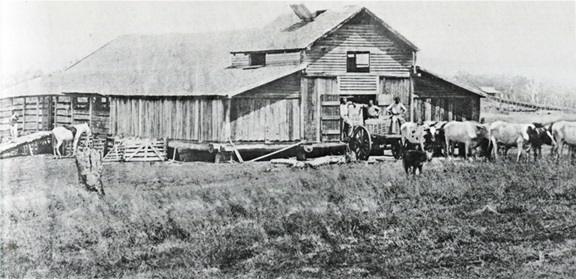
McTaggart’s Woolshed, ca 1860s. Photograph source: Kirk of Coivan Facebook Page.
He decided at first to start grazing sheep in the area. There were no wool scours back then, so to keep the fleece clean, he would take the sheep to a nearby creek and wash them before shearing. It was very hard back then to make a living (Logan, 1988). John McTaggart faced many challenges, including drought, economic pressures and lack of food for his sheep. One of the biggest problems was the growth of spear grass in the area, which took over the landscape in times of drought. McTaggart quickly realised that the spear grass was, unfortunately, poisonous to sheep. As a result, he stopped sheep farming and took up grazing cattle instead, as cattle were able to eat the spear grass (Logan, 1988).
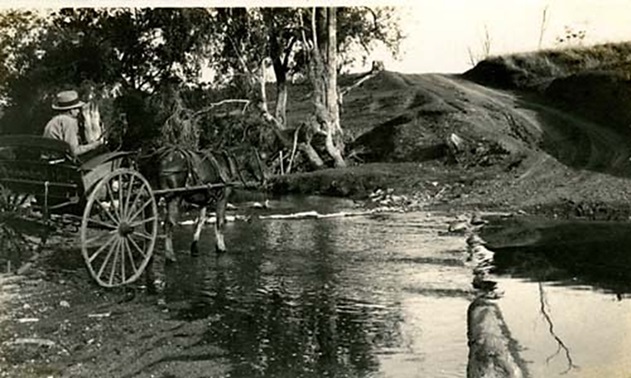
Crossing the creek near Kilkivan, ca 1910. Photo: Gympie Library Photo Collection.
Following this, J.D McTaggart continued to live and work in Kilkivan until he passed away in 1871. His grave is on the hilltop of “Kilkivan” which overlooks the property which he established (Logan, 1988).
“Kilkivan” remained in the McTaggart family until it was purchased by G.H Jones and D.M Jones of Boonara station. The property remained in the Jones family until it was sold to the Government in 1911 (Logan, 1988).
In 1852, gold was first discovered near Kilkivan. No gold rush occurred during this time however, as J.D McTaggart concealed the assay details (Kilkivan Historical Society, 2008). Later, in 1868, gold was found at West Coast Creek by some New Zealand miners, which started a gold rush. While it is unclear exactly how many people came to the area, some reports suggest up to 12,000 miners occupied Kilkivan during this time (De Havelland, 1987). West Coast Creek then became the very first site of the Kilkivan township.
Following this, in 1873, a gold reef called the “Rise and Shine” was discovered at the eastern end of what is now Bligh Street (near the Rifle Range). It was at this time that more keen gold seekers flocked to the area. By late 1868, the township was renamed to “Rise and Shine” (De Havelland, 1987). Among the new arrivals were a significant number of Chinese prospectors, some of whom continued prospecting, while others chose to set up vegetable gardens in the area.
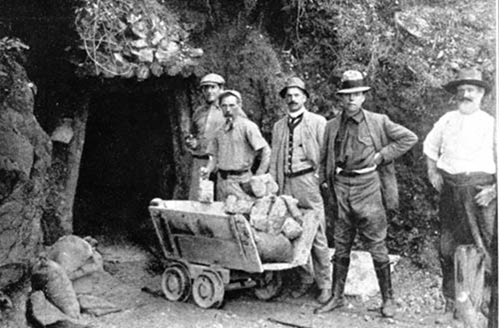
Gold Mining near Kilkivan, ca 1914. Photo: Gympie Library Photo Collection
Following this, the township was briefly named Neureum (after a nearby mountain), before it was changed back to its original name, Kilkivan. The arrival of the railway in 1886 saw the town move to where the current bowls club is. Another minor town relocation occurred following this, as the railway line was extended westward in 1902 (Kilkivan Historical Society, 2008).
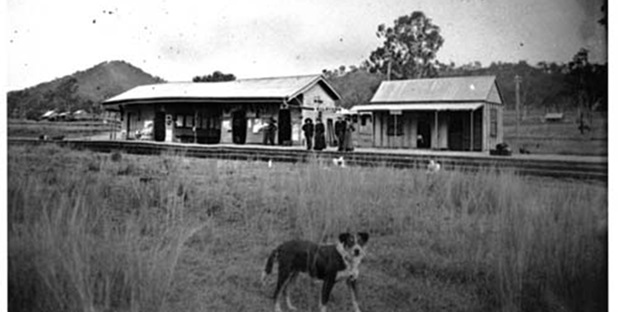
Kilkivan Railway Station, year unknown. Photo: Gympie Library Photograph Collection.
Shortly after the gold rush in 1868, the township started to grow. At this time, Kilkivan became home to four hotels and several general stores including a local bakery (Kilkivan Historical Museum, 2025).
In 1876, the Rise and Shine School was built on the site of the Rise and Shine goldfield, and the Union, Anglican and Catholic churches were also completed between 1880-1888 (Kilkivan Historical Museum, 2025).
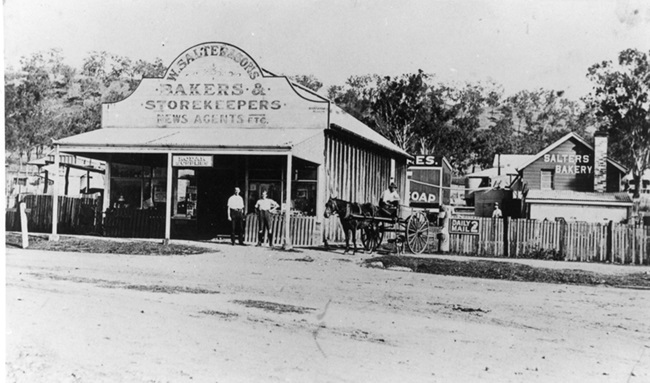
W. Salter’s Bakery and General Store, year unknown. Photo: Gympie Library Photo Collection.
By the early 1900s, the gold fever had subsided due to a lack of significant finds in the area. By this time, Kilkivan had established itself as a rural community, as most farmers in the area undertook dairying, grazing or timber ventures (Kilkivan Historical Museum, 2025).
In 1911, Kilkivan Station (originally owned by the McTaggart family) was resumed by the government and broken up into smaller holdings.

Bottle Tree in Kilkivan, year unknown. Photo: State Library of Queensland.
As time passed, Kilkivan saw the loss of many of its prime industries due to the lack of economic viability. The 1960s saw the end of the dairy industry and following that, the timber industry slowed down and eventually ceased when sawmills in the area shut down. Job losses also occurred when the telephone exchanges became automatic. Grain growing in the area also dwindled as it become uneconomic to harvest smaller areas (Kilkivan Historical Museum, 2025).
Today, the Kilkivan township is home to some family-owned businesses and farms. Beef cattle farming is still a large industry in the Kilkivan area.
References:
-De Havelland, D.E. (1987). Gold & ghosts vol 3 Queensland. Central & southern districts : a prospector’s guide. Carlisle, WA: Hesperian Press. pp.1-300.
-Logan, D. (1988). Where two rivers run : a history of Kilkivan Shire. Kilkivan: Kilkivan Shire Council. pp.1-492.
-Kilkivan Historical Society (2008). KILKIVAN HISTORICAL TOWN WALK. [brochure]. Kilkivan: Kilkivan and District Historical Museum.
-Kilkivan and District Historical Museum. (2025). KILKIVAN. [brochure]. Kilkivan: Kilkivan and District Historical Museum.
Click on the links below to learn more about the history of Kilkivan:
 Gympie Regional Memories