The Kilkivan area is rich in gold and many other minerals such as copper, silver, mercury, cobalt, limestone, nickel, lead and manganese. Read on to learn more about the gold rush in Kilkivan and about other keen prospectors who mined the Kilkivan area for a range of precious minerals.
The Gold Rush
In 1852, gold was first found near Kilkivan. No gold rush occurred during this time however, as John Daniel McTaggart (an early grazier in the Kilkivan area) concealed the assay details. Later, in 1868, gold was found at West Coast Creek by some New Zealand miners, which started a gold rush. While it is unclear exactly how many miners came to the area during this time, some reports suggest up to 12,000 miners occupied Kilkivan during this time (De Havelland,1987). West Coast Creek then became the very first site of the Kilkivan township. Following this, in 1873, a gold reef called the “Rise and Shine” was discovered at the eastern end of what is now Bligh Street (near the Rifle Range). It was at this time that more keen prospectors flocked to the area. By late 1868, the township was renamed “Rise and Shine” (Logan,1988). There were also a significant number of Chinese prospectors who came to the area, some of whom continued prospecting, but others chose to set up vegetable gardens in the area. Following this, the township was briefly named Neureum (after a nearby mountain), before reverting to its original name, Kilkivan. The arrival of the railway in 1886 saw the town move to where the current bowls club is (Logan,1988). Then, a minor town relocation occurred following this, as the railway line was extended westward in 1902 (Kilkivan and District Historical Museum, 2025).
One of the most memorable finds in the Kilkivan area was a gold nugget weighing 73 ounces (just over 2kgs). By 1872 though, gold discoveries became few and far between.
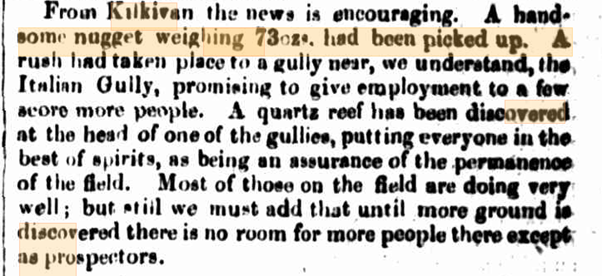
Newspaper article from the Queensland Times, Ipswich Herald and General Advertiser, 18th of August 1868, page 3.
Mercury
Mercury was discovered in Kilkivan in 1872. These mercury deposits started to attract a lot of attention, especially from buyers and miners overseas. In 1886, the Duke of Manchester visited Kilkivan and bought several mercury deposits on behalf of the Queensland Quicksilver Company Ltd (Brooks, 1974). The total production of about 15,331kg of mercury was mined from the Kilkivan area up until 1945. The mercury production in Kilkivan alone represented about 90% of Australia’s total mercury production up until 1945 (Brooks, 1974). During the gold rush, mercury was an essential mineral which was used in gold processing. This is significant, as this abundant source of mercury is what made gold mining so viable in Gympie and the surrounding areas.
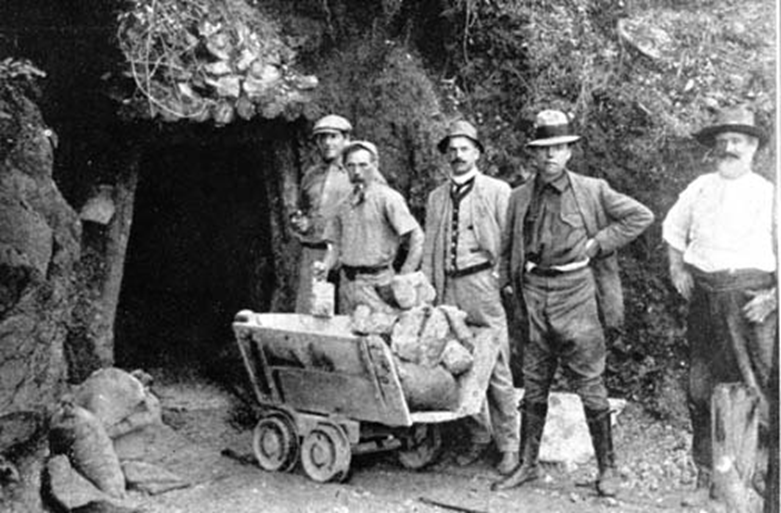
Gold Mining near Kilkivan, ca 1914. Photo: Gympie Library Photo Collection.
Copper
Copper was also discovered in Kilkivan in 1871 in the Mount Clara and Mount Coora areas. In 1872, the Mount Clara copper mining venture began. To process the copper, eight furnaces were built and railway lines were also built to carry timber to the furnace (Fraser Coast Chronicle, 2017). As well as this, a chimney which was 16.5m in height was constructed. The chimney was made of local bluestone and bonded together with clay mortar. The mines and smelter employed around 300 men and the smelter ran non-stop for 24 hours a day, with men working shifts to operate the furnace. The mines and smelter operated for just three years, before it shut down in 1875 (Fraser Coast Chronicle, 2017). Remains of this smelter (primarily the chimney stack) can still be seen today. Access to the chimney is via Wide Bay Highway (east of Kilkivan) and approximately 15 km up Rossmore Road. It is said to be the last one of its type left in Queensland.
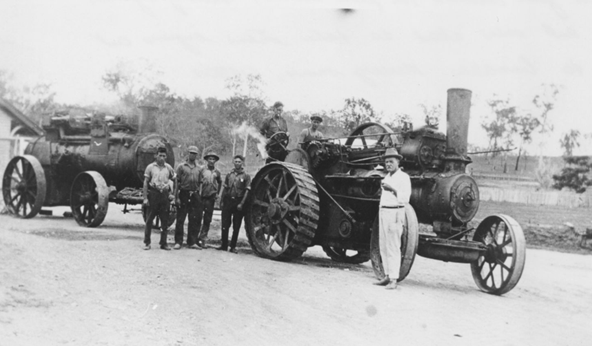
John Lennox and men taking steam engines to the mercury mines at Cinnebar (near Kilkivan), Queensland, ca. 1935. Photo: State Library of Queensland.
Cobalt
In 1874, the Black Snake cobalt reef was discovered. This helped to sustain the town financially until around 1902 (Aussie Towns, 2025).
References:
-Aussie Towns. (2025). Kilkivan, QLD. [Online]. Aussie Towns. Last Updated: 2025. Available at: https://www.aussietowns.com.au/town/kilkivan-qld#:~:text=There%20are%20a%20number%20of,Clara%20and%2 [Accessed 19 June 2025].
-Brooks, J.H. (1974). Mineral Resources of the Kilkivan District, Report Number 60, Geological Survey. Brisbane: Geological Survey of Brisbane. pp.1-49.
-De Havelland, D.E. (1987). Gold & ghosts vol 3 Queensland. Central & southern districts : a prospector’s guide. Carlisle, WA: Hesperian Press. pp.1-300.
-Fraser Coast Chronicle. (2017). Mt Clara: Hundreds used to work there, now it’s abandoned. Fraser Coast Chronicle. [Online]. 12 December 2017. Available at https://www.couriermail.com.au/news/queensland/fraser-coast/mt-clara-hundreds-used-to-work-there-now-its-abandoned/news- [Accessed 19th of June, 2025].
-Kilkivan and District Historical Museum. (2025). KILKIVAN. [brochure]. Kilkivan: Kilkivan and District Historical Museum.
-Logan, D. (1988). Where two rivers run : a history of Kilkivan Shire. Kilkivan: Kilkivan Shire Council. pp.1-492.
-Queensland Times, Ipswich Herald and General Advertiser. (1868). Gympie. Queensland Times, Ipswich Herald and General Advertiser. [Online]. 18 August 1868. Available at https://trove.nla.gov.au/newspaper/article/123352407?searchTerm=gold%20discovered%20kilkivan%2073oz [Accessed 19th of June, 2025].
Click on the links below to learn more about the history of Kilkivan:
Click on the link below to watch a video about the history of gold mining in Gympie.
 Gympie Regional Memories