The Hall of Memory
The Hall of Memory in Goomeri was opened in 1926, designed to commemorate soldiers from the Goomeri district who had served in the First World War; however it now also honours soldiers from the area who have fought in subsequent wars. The Goomeri RSL sub-branch and its members were the driving force behind the establishment of the Hall of Memory, and in March 1926 a Memorial Hall Building Committee was established following a public meeting. The committee was comprised of Mr. Mayne, Mr. Stanton, Mr. Wimberley, Mr. Maudsley, and Mr. Wise, who were given the authority to obtain land and a building for use as a community hall.
The committee purchased a pre-existing timber store building from Cuthbert Butt in Nanango, which was erected by Mr. A Kopp and Mr. W Toop, and was delivered to the site in Goomeri by May 1926. The hall was initially leased to Mr. A Rich, who moved his silent picture show to the hall from Boonara. To help clear the debt outstanding from the purchase of the hall, a variety of fundraising events were held in 1927 such as a concert and ball, a sports day and process, and a popular girl competition – which was won by Myrtle Wieland, one of the cinema pianists. In 1931, a large supper room with a kitchen was added though the room was also used for meetings and other smaller functions. Mr. A Duffy held a long lease on the hall to show films, also acting as its caretaker. He installed electricity and equipment to show “talkies” (films with soundtracks), and in the 1940s become one of the first theatre operators in the country to install cinemascope.

Fancy dress ball at the Hall of Memory Goomeri, 1930s. Photo Source: State Library of Queensland.
During the Second World War, the basement of the Hall of Memory was used to store up to 600 tons of emergency supplies for the Goomeri area in case of Japanese invasion. Following the end of the war, the supplies were removed, and the space was repurposed and portioned for use as clubrooms by the RSL. During the 1950s, the demand for film shows had declined: films were shown only once a week and were eventually discontinued entirely in the late 1950s, though the hall continued to be used for other events. In 1971, Kilkivan Shire Council accepted responsibility for the hall at the request of the Trustee and renovated the kitchens, installing a bar and cold room. The RSL kitchenette was modernised in 1991, and it’s believed that the hall was re-roofed in 1995. The hall is still in use today for a wide variety of entertainment activities and social functions.
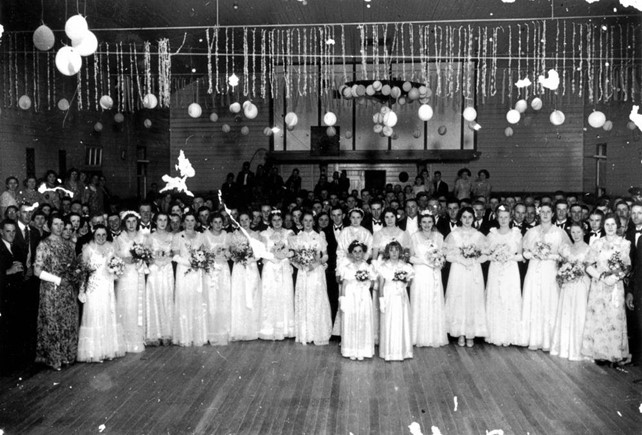
Debutantes Ball, Goomeri, 1930s. Photo source: State Library of Queensland.
The Memorial Clock
The Goomeri War Memorial Clock was unveiled on the 15th of November 1940 by RSL State President R.D. Huish. The southern face of the concrete memorial honours the nine local men who fell in the First World War. The names of twelve local servicemen who fell in the Second World War have since been added on the western face. The monument itself is 74 feet tall and consists of a tapered tower with clockfaces at its apex. It cost £700 to erect, which was raised by the Goomeri RSL sub-branch. Although many different types of war memorial monuments were erected throughout Queensland, the clock type found in Goomeri was comparatively rare. It is unknown who designed the memorial, though it is known that the metal work was produced by Ernest Gunderson and was originally part of an earlier monument also commemorating the First World War.

Source: Murray Views Postcard, 1980s, Gympie Library Photo Collection.
References:
-Logan, D. (1988). Where two rivers run : a history of Kilkivan Shire. Kilkivan: Kilkivan Shire Council. pp.1-492.
-Goomeri Heritage Writers Group. (2000). Neverending stories: a tribute to our pioneers. Goomeri: Goomeri Heritage Writers. pp.1-334.
 Gympie Regional Memories