The lighthouses and light stations in the Rainbow Beach area have a fascinating history which dates back to the late 1800s. Read on to learn more about the history of the Inskip Point Light and Signal Station and the Double Island Point Lighthouse.
The Inskip Point Light and Signal Station
An early Rainbow Beach resident was a man by the name of John Smith. In 1872, he became first pilot of the light and signal station at Inskip Point (Walding, 2025). In 1873, George Byrne was appointed as head light keeper. Sadly, several landslips occurred during that year and all of George’s belongings, including the boat shed, boats, tent and provisions were washed away. In 1875, a man called Samuel Reilly joined as the pilot and receiving officer. He came to Inskip with his wife Emily and his five-month-old daughter (Walding, 2025).
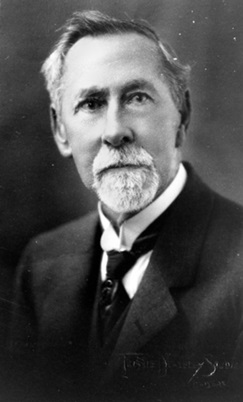
George Byrne, head light keeper at Inskip Point. Source: State Library of Queensland.
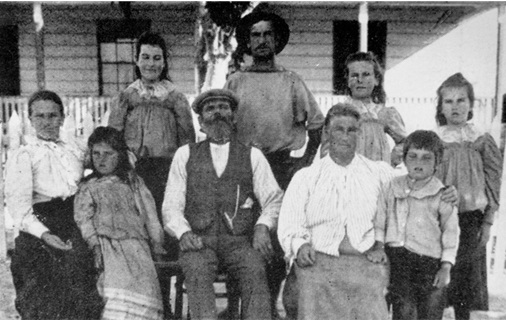
The Reilly family at Inskip Point, 1902. Source: State Library of Queensland.
There was also a school near the light station at Inskip point, called Inskip Point Provisional. This school was opened in 1884 and serviced the children of the area. Mrs Mary Garsden was the first teacher at Inskip Point. In saying this, she only taught for three months before she resigned, as the sea air caused her to experience violent headaches. The next teacher was Margaret Kenny. She also only last three months before her employment was terminated due to poor enrolments. The next teacher was 22-year-old Greta Herley, who lasted about a year, with 14 students enrolled (Walding, 2025). Following this, the next teacher was Mrs Teresa Sullivan. She was very experienced, and she lasted another four years before resigning in 1888. She was later replaced by Mrs Cafferty. The school then closed in 1896 due to low enrolments.
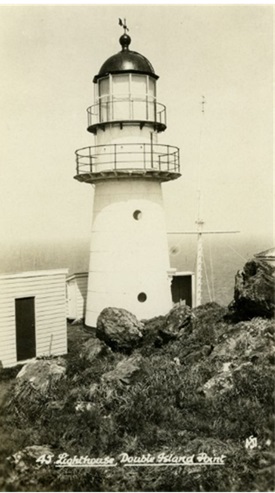
Double Island Point Lighthouse, 1938. Source: State Library of Queensland.
The Double Island Point Lighthouse
In 1884, the Double Island Point lighthouse and nearby cottages were completed. The lighthouse was 12 metres in height and made from iron and timber. It was constructed 96 metres above the foaming sea (Turner, 2015). In September of 1884, the Double Island Point lighthouse shone its light for the first time. This provided a much-needed service for ships (who prior to this frequently wrecked at or near Double Island Point). From 1891, it was the lighthouse keeper’s job to record the weather and report their observations via the telegraph line to Maryborough (Turner, 2015). Government ships brought monthly supplies to the lighthouse which were rowed to shore. When supplies ran low, the lighthouse staff were required to travel by horse and cart all the way to Inskip Point, to fetch supplies from the other light station there. As you can imagine, this was no easy task with no established roads or tracks, not to mention the steep hill climb back up to the lighthouse on the return trip (Turner, 2015).
Today the lighthouse still flashes but is automated. The last lighthouse keepers at Double Island Point left in 1992.
There was also a school at Double Island Point. Double Island Provisional school was the second school to open in the area in 1887. This school serviced 10 children initially before closing in 1922 due to low enrolments (Turner, 2015).
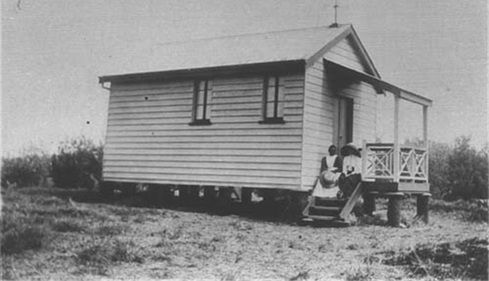
Double Island Point School, year unknown. Source: Ron Turner.
References
Turner, R. (2015). Double Island Point Lighthouse. Gympie: Ron and Yvonne Turner. pp.1-72. Last Updated: 2015. Available at: https://www.esplash.me/ebook/eBook_Ron_&_Yvonne_Turner_Double_Island_Point_Lighthouse.pdf [Accessed 18 August 2025].
Walding, R. (2025). INSKIP POINT LIGHT AND SIGNAL STATION. [Online]. Inskip Point. Last Updated: 2025. Available at: https://indicatorloops.com/inskip.htm [Accessed 18 August 2025].
Article published on 8th of September, 2025.
 Gympie Regional Memories