In Imbil’s history there were several early graziers who took up land in the 1850s. The first known grazier in the Imbil area was John McTaggart (Gray, 2017). In July of 1851, he submitted a tender for two portions of land called Bunya Creek and Bluff Plains to graze livestock. The area of each run was 16,000 acres. It was only in 1857 however, that the tender for these two runs was accepted.
In 1857, John McTaggart sold the leases of these runs to Clement and Paul Lawless (Gray, 2017). The two runs were then consolidated under the Crown Lands Alienation Act of 1868, and the new run was called “Imbil” (King, 2001).
In 1860, the original Imbil homestead was built. The homestead was built almost completely from red cedar timber, which had been pit sawn and hand dressed. Other buildings at the station included workmen’s cottages, barns and a butcher’s shop (King, 2001).
In October of 1873, with Imbil Station supporting 3000 head of cattle, John Elworthy and Matthew Mellor took over the “Imbil” lease from the Lawless family (Gray, 2017). Over the years that followed, Elworthy and Mellor had parts of the Imbil lease converted to freehold by meeting certain conditions set by the government. The main conditions were that the land needed to be leased for 20 years or more, in which time it had to be improved (by establishing some fencing and a hut on the property) and that the land also needed to be occupied. Elworthy had five or six of these selections (with each one being 640 acres in size) even though typically each person was only supposed to have one selection due to the requirement that each selection needed to be occupied (King, 2001). What Elworthy did to satisfy this requirement however was to employ contractors to fence and live on each selection. He even let his wife and children occupy different selections so they could technically be owned by him (King, 2001).
So, as years passed, around 1882, a new homestead at Imbil was built for William Elworthy. This homestead featured four bedrooms and was constructed from beech, white cedar and silky oak (King, 2001). In 1925, the shingle roof was replaced with galvanised iron. The kitchen, which was a separate building entirely, featured at least six bedrooms and this is where the household staff lived. When the kitchen burnt down, a new kitchen was built on one of the verandas adjoining the main building. In 1897, the Imbil provisional school opened at the Imbil Homestead and continued there until the school building was completed. A new State school building was eventually constructed in 1916 (King, 2001).
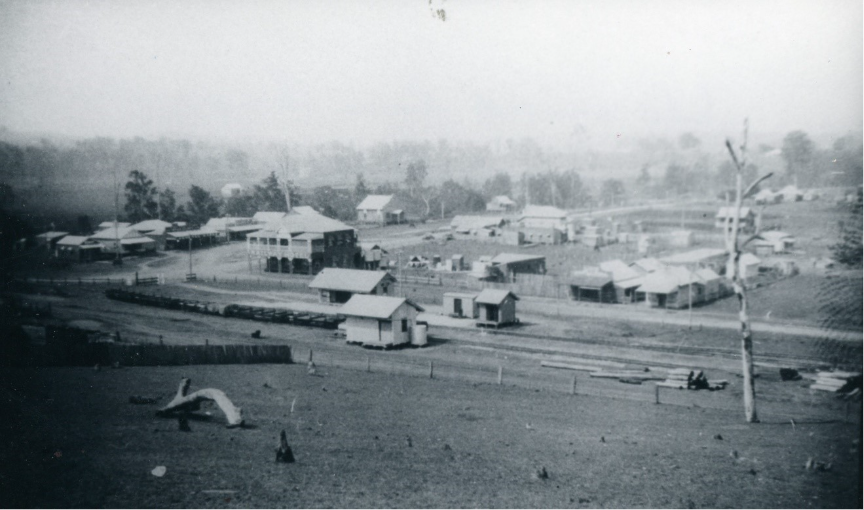
View of Imbil looking north-east from Elizabeth Street. The largest building in this image is the Railway Hotel. Source: Gympie Library Photograph Collection.
References:
Gray, W. (2017). Imbil Station, Queensland, Australia – 1903. [Online]. Forgotten Victorians. Last Updated: 24 January 2017. Available at: https://williamgray101.wordpress.com/2017/01/24/imbil-station-queensland-australia-1903/ [Accessed 7 January 2026].
King, Joy. (2001). Imbil: Jewel of the Mary Valley. Imbil: Joy King. pp 1-244.
Post published 24th of February 2026.
 Gympie Regional Memories