In the early to mid 1840’s, three grazing stations were established in what would become known as the Goomeri region. These were the Barambah station, Booubyjan station, and the Boonara station, the latter serving as the original location for the Goomeri township itself. Barambah station was established in 1943 by Mr. J Ferriter and Mr. E Uhr, covering 164,000 total acres and was used for sheep and cattle farming. Booubyjan station was established in 1846 by Clement and Paul Lawless, initially as a sheep station before later incorporating cattle as well. It is one of the few properties in Queensland which is still owned and worked by the family that originally established the station.
Also in 1846, Edward Hawkins selected 160,000 acres of land in the area to establish a sheep station – this would become known as Boonara Station and would incorporate the area that the Goomeri township is located in today. Early pastoralists struggled to effectively manage their stations during this period due to the lack of formally established roads, and Edward would use bullock teams to transport wool, hides and tallow to the coast. The trip would often take weeks due to poor road quality, rough mountain passes, and flooding. On his return trips, he would gather and bring back enough supplies to last for twelve months.
In 1849, Edward heard about the gold rush in California and left Australia to seek gold overseas, leaving a man named Berthelson in charge of the station in his absence. Shortly after, the station was taken up by Mr David Jones and Mr George Jones from Sydney – the founders of the well-known retail store “David Jones”. The Jones family had taken over Boonara Station during a very difficult time, and they faced severe labour shortages as most migrants came to Australia via Sydney and would stay to work there. The discovery of gold in nearby Kilkivan in 1868 brought more people further north looking for work, which helped alleviate the station’s labour shortages, and there is evidence that the station employed many Chinese and German immigrants.
Around 1862, the slab hut that Edward had originally erected for his accommodation was replaced by a grand colonial homestead, and a small village would be erected on the station consisting of other slab huts, stores, and a woolshed. Boonara would soon become a fully operational sheep station carrying over 60,000 sheep, though the station would experience a major setback around 1890. During this time droughts began to affect the Goomeri area, leading to the growth of spear grass, which is poisonous to sheep. The Jones family would adapt by swapping to cattle farming. Boonara Station would remain under the ownership of the Jones Family until 1911 when they sold large portions of the land to the Goomeri Land Company, though they kept a few thousand acres and the homestead in their own name.
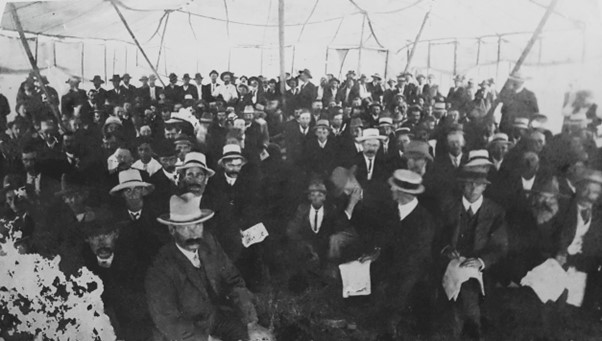
The great land sale in Goomeri, 1911. Photo source: Goomeri History Facebook page, originally from E.D. Euler, WARR.
In 1909, five young men – Mr. R Reid, Mr. G Reid, Mr. W Herwig, Mr. W McIvor and Mr. H Silburn – travelled from Sydney to settle west of Goomeri, establishing the Reid Group settlement. They formed “The Reid Group” in 1910 and applied for a selection of crown land to clear and work on, which was approved after the government deemed the men capable of undertaking the work. Having travelled from Sydney, the men had little experience in timber getting and so learned primarily through trial and error. When they had finally cleared the lane, they began to grow maize and corn which was carted by bullock teamster Jim Downing. Many of the original members of the Reid Group went on to live in Goomeri and establish their presence in the community as local business owners.

W. McIvor’s General Store, Goomeri. Photo source: Heather McIvor, Goomeri History Facebook page.
References:
-Logan, D. (1988). Where two rivers run : a history of Kilkivan Shire. Kilkivan: Kilkivan Shire Council. pp.1-492.
-Goomeri Heritage Writers Group. (2000). Neverending stories: a tribute to our pioneers. Goomeri: Goomeri Heritage Writers. pp.1-334.
Click on the links below to learn more about Goomeri’s history:
 Gympie Regional Memories